


Your shopping cart is empty!
Tobacco "Delgold"
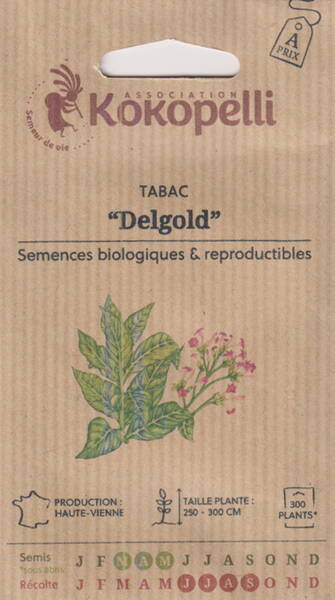
Eco seeds
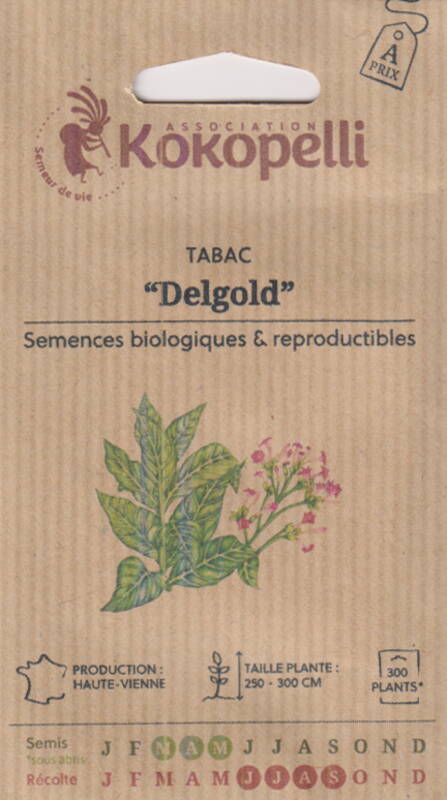
Smoking tobacco "Delgold" - Nicotiana tabacum L.
A mid-season variety (105 days from planting to the ripening of the leaves of the last priming) with a low nicotine content (about 0.63%) and excellent smoking properties (based on strength, aroma, taste, and sweetness - 42 points).
Flowers: Pink.
Plant height: 250 to 300 cm.
Leaf size: 30 to 45 cm.
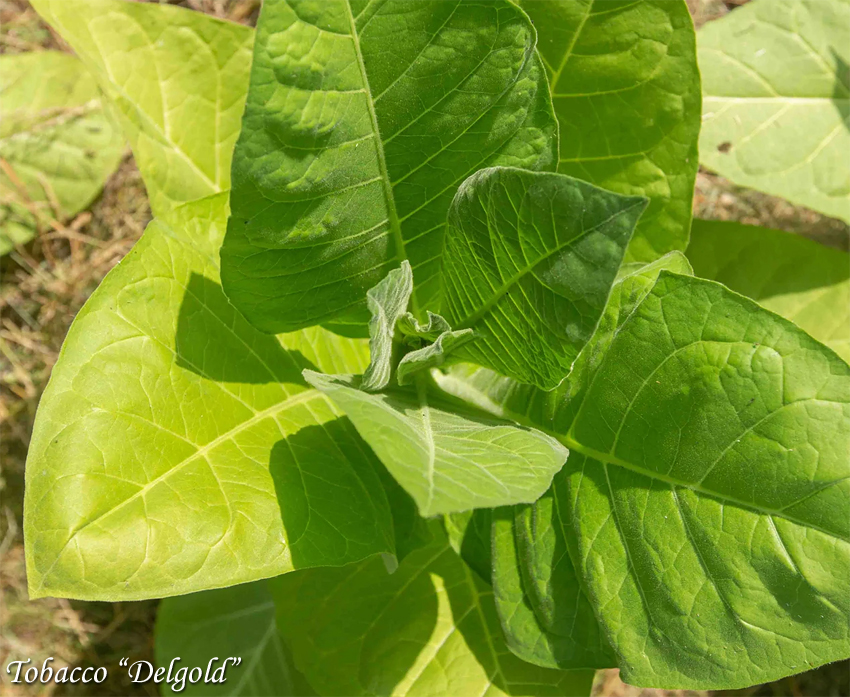
An oval-shaped plant with elliptical, slightly pointed yellow-green leaves. The plant develops 25-27 leaves.
The variety is resistant to root rot, tobacco mosaic virus, and downy mildew. The yield of first-grade raw material is 95-97%.
Recommended for cigarettes and smoking pipes.
Variety history: This variety was created around 1980 in Canada by crossing Nicotiana rustica with two Nicotiana tabacum varieties: «Virginia 115» and «Hick's Broadleaf».
Agrotechnics.
Sowing for seedlings is carried out in late March — early April. Before sowing, the container is filled with slightly moist soil (three parts sandy loam turf soil and one part well-rotted and sifted humus), the surface is compacted and leveled. The seeds are evenly distributed over the surface, slightly pressed into the substrate, moistened from a spray bottle, and covered with a film. The crops are placed in a bright, warm place, watered through a tray, and ventilated every day (lifting the film for 30 minutes).
Young plants are planted in open ground in mid-to-late May at a distance of 50-70 cm.
From mid-July, the harvesting and curing of tobacco begins. Tobacco is fermented before use.
A mid-season variety (105 days from planting to the ripening of the leaves of the last priming) with a low nicotine content (about 0.63%) and excellent smoking properties (based on strength, aroma, taste, and sweetness - 42 points).
Flowers: Pink.
Plant height: 250 to 300 cm.
Leaf size: 30 to 45 cm.
An oval-shaped plant with elliptical, slightly pointed yellow-green leaves. The plant develops 25-27 leaves.
The variety is resistant to root rot, tobacco mosaic virus, and downy mildew. The yield of first-grade raw material is 95-97%.
Recommended for cigarettes and smoking pipes.
Variety history: This variety was created around 1980 in Canada by crossing Nicotiana rustica with two Nicotiana tabacum varieties: «Virginia 115» and «Hick's Broadleaf».
Agrotechnics.
Sowing for seedlings is carried out in late March — early April. Before sowing, the container is filled with slightly moist soil (three parts sandy loam turf soil and one part well-rotted and sifted humus), the surface is compacted and leveled. The seeds are evenly distributed over the surface, slightly pressed into the substrate, moistened from a spray bottle, and covered with a film. The crops are placed in a bright, warm place, watered through a tray, and ventilated every day (lifting the film for 30 minutes).
Young plants are planted in open ground in mid-to-late May at a distance of 50-70 cm.
From mid-July, the harvesting and curing of tobacco begins. Tobacco is fermented before use.
* Today we know that it is exactly the hundreds of chemicals, additives, and addictive components (present by the thousands in cigarette smoke) that make tobacco a deadly plant. The tobacco industry and the economic interests generated by its sale present it to us as a highly carcinogenic plant, and for good reason, but it is important to distinguish between tobacco as a medicinal and sacred plant and what is sold to us under the "smoking kills" label.
Often referred to as a "master plant" (plante maîtresse) by many tribes, it has been used since time immemorial through the gastrointestinal or respiratory tract — in the form of juice, chewing or smoking tobacco — for a wide variety of purposes. As snuff, it is famous for its ability to treat migraines. In homeopathy, a very low dose of Nicotiana tabacum is also prescribed for migraines, nausea, vomiting, and circulatory problems. Tobacco is apparently still used to fight parasites. Historically, it was used to relieve asthma, coughs, rheumatism, gout, pain and neuralgia, epilepsy, and for cleansing enemas.
In 1614, the physician William Barclay wrote: «With moderate use, there is no medicine comparable to tobacco. Everything in this plant has healing properties.»
Indigenous peoples and many Latin American tribes use tobacco in ceremonies to communicate with spirits (through smoke), give thanks to the Creator, pray for a good harvest and a successful catch of fish, make peace with an enemy (peace pipe), or during rites of passage.